
Happiness itself is a commons to which everyone should have equal access.
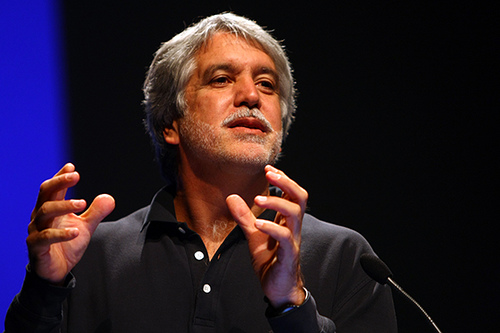
That’s the view of Enrique Peñalosa, who is not a starry-eyed idealist given to abstract theorizing. He’s actually a politician, who served as mayor of Bogotá, Colombia, for three years, and now travels the world spreading a message about how to improve quality-of-life for everyone living in today’s cities.
Peñalosa’s ideas stand as a beacon of hope for cities of the developing world, which even with their poverty and immense problems will absorb much of the world’s population growth over the next half-century. Based on his experiences in Bogotá, Peñalosa believes it’s a mistake to give up on these cities as good places to live.
Celebrate the new toolkit
Limited time only! Help us celebrate version 2.0 of the Library of Things Toolkit by chipping in $100 and receive an advance print edition.
“If we in the Third World measure our success or failure as a society in terms of income, we would have to classify ourselves as losers until the end of time,” declares Peñalosa. “So with our limited resources, we have to invent other ways to measure success. This might mean that all kids have access to sports facilities, libraries, parks, schools, nurseries.”
Peñalosa uses phrases like “quality of life” or “social justice” rather than “commons-based society” to describe his agenda of offering poor people first-rate government services and pleasant public places, yet it is hard to think of anyone who has done more to reinvigorate the commons in his or her own community.
 Credit: Felipe Andrade
Transforming Bogotá
In three years (1998-2001) as mayor of Colombia’s capital city of 7 million, Peñalosa’s Administration accomplished the following:
- Led a team that created the TransMilenio, a bus rapid transit system (BRT), which now carries a half-million passengers daily on special bus lanes that offer most of the advantages of a subway at a fraction of the cost.
- Built 52 new schools, refurbished 150 others and increased student enrollment by 34 percent.
- Established or improved 1200 parks and playgrounds throughout the city.
- Built three central and 10 neighborhood libraries.
- Built 100 nurseries for children under five.
- Improved life in the slums by providing water service to 100 percent of Bogotá households.
- Bought undeveloped land on the outskirts of the city to prevent real estate speculation and ensured that it will be developed as affordable housing with electrical, sewage, and telephone service as well as space reserved for parks, schools, and greenways.
- Established 300 kilometers of separated bikeways, the largest network in the developing world.
- Created the world’s longest pedestrian street, 17 kilometers (10.5 miles) crossing much of the city as well as a 45- kilometer (28 miles) greenway along a path that had been originally slated for an eight-lane highway.
- Reduced traffic by almost 40 percent by implementing a system where motorists must leave cars at home during rush hour two days a week. He also raised parking fees and local gas taxes, with half of the proceeds going to fund the new bus transit system.
- Inaugurated an annual car-free day, where everyone from CEOs to janitors commuted to work in some way other than a private automobile.
- Planted 100,000 trees.
 Credit: Carlos Felipe Pardo
Quality of Life = Common Wealth
All together, these accomplishments boosted the common good in a city characterized by vast disparities of wealth. Peñalosa is passionate in articulating a vision that a city belongs to all its citizens.
David Burwell—a strategic analyst with Project for Public Spaces who has long experience working on environmental, transportation, and community issues—calls Peñalosa, “One of the great public servants of our time. He views cities as being planned for a purpose—to create human well-being. He’s got a great sense of what a leader should do—to promote human happiness.”
Bogota is now held up as an international model for sustainable innovation, even for cities in the developing world. Peñalosa of course, didn’t do this alone. Antanas Mockus, who both preceded and succeeded him as mayor, and Gil Peñalosa, Enrique’s brother, who served as parks commissioner under Mockus, are among the many who deserve credit. Bogota mayors are limited to one consecutive three-year term. Peñalosa ran again for mayor in 2008, losing according to some observers because a leftist opponent also embraced a commons-style agenda, including the promise of a new subway system.
Enrique Peñalosa has become an international star of sorts among green urban designers, so I assumed he was trained as a city planner and inspired by long involvement in the environmental movement. But the truth is that he arrived at these ideas from a completely different direction. “My focus has always been social—how you can help the most people for the greater public good.”
Growing up in the 1960s, when revolutionary fervor swept South America, Peñalosa became an ardent socialist at a young age, advocating income redistribution as the solution to social ills. He studied economics and history at Duke University in the United States, which he attended on a soccer scholarship, and later moved to Paris to earn a doctoral degree in management and public administration. Paris was a marvelous education in the possibilities of urban living, and he returned home with aspirations of bringing European-style city comforts to the working class of Bogotá. Several years working as a business manager moderated his ideological views but not, he hastens to tell me, his quest for social justice.
 Credit: Pattoncito
Thinking about Equality in New Ways
“We live in the post-communism period, in which many have assumed equality as a social goal is obsolete,” he explains. “Although income equality as a concept does not jibe with market economy, we can seek to achieve quality-of-life equality.”
Quality of life is not just a phrase to Peñalosa. He is firmly dedicated to giving everyone in a city more opportunity for recreation, education, transportation and the chance to take pleasure in their surroundings. That explains his emphasis on parks, mass transit, childcare facilities, bikeways, schools, libraries and other forms of the commons that enhance people’s lives. And that focus on serving the disadvantaged extends to public space—which he explains is where poor people who do not have backyards, vacation homes and private clubs tend to hang out.
Peñalosa is proud of how his administration tamed the automobile in Bogota in order to meet the needs of those who do not own cars. Nearly all cities around the globe accommodate motorists at the expense of everyone else, turning the streets—a commons that once was used by everyone, including pedestrians and kids at play—into the exclusive domain of motorists. In the developing world, where only a select portion of people own motor vehicles, this is particularly unfair and detrimental to a sense of community.
The streets were reclaimed for people through policies that used both carrots and sticks. As expected, the sticks—driving bans during rush hour and enforcement of long-ignored laws prohibiting cars on the sidewalks—drew howls of outrage from a small but powerful group of people, who had always treated sidewalks as their own personal parking lot.
“I was almost impeached by the car-owning upper classes,” Peñalosa recalls, “but it was popular with everyone else.”
However, the carrots were embraced by almost everyone. The pedestrian streets, greenways and bike trails he created are well used on weekdays by commuters and on evenings and weekends by recreational bikers and walkers out enjoying the Latin custom of a paseo—an evening stroll.
 Credit: Carlos Felipe Pardo
Streets for People, Not Just Cars
Another hit is the Ciclovía, in which as many as 2 million people (30 percent of the city’s population) take over 120 kilometers of major streets between 7 a.m. and 2 p.m. every Sunday, for bike rides, strolls and public events. This weekly event began in 1976 but was expanded by Peñalosa. It now has spread to numerous Colombian cities as well as San Francisco; Quito, Ecuador; El Paso, Texas; Las Cruces, New Mexico; and is being explored for Chicago, New York, Portland and Melbourne, Australia.
Peñalosa’s proudest achievement is TransMilenio, the bus rapid transit (BRT) system that enables buses to zoom on special lanes that make mass transit faster and more convenient than driving. There are now eight TransMilenio routes criss-crossing Bogotá. The BRT idea was pioneered in Curitiba, Brazil, in the 1970s but Bogotá’s success shows it can work in a larger city.
Oscar Edmundo Diaz, senior program director for the Institute for Transportation and Development Policy (ITDP), who was Peñalosa’s chief mayoral aide, proudly notes that even wealthy people who own cars are now enthusiastic users of the BRT. “You don’t want to build a transit system just for the poor,” he counsels. “Otherwise it will be stigmatized, and even poor people will look down on it. If everyone uses it, it will help the poor more.”
Wowed by the success of TransMilenio, six other Colombian cities are developing their own systems. And Peñalosa and Diaz have been very influential in spreading the idea throughout the world. In 2004, Jakarta, Indonesia, inaugurated TransJakarta, a Bogotá-inspired BRT system that now features six lines with three more under construction. Dozens of other cities around the globe have BRT projects under construction or up-and-running, including Hong Kong; Mexico City, Mexico; Johannesburg, South Africa; Taipei, Taiwan; Quito, Ecuador; and Dar-es-Salaam, Tanzania. The idea is now spreading to cities in developed countries including Sydney, Ottawa, Pittsburgh, and even the city known for decades as the world center of automotive glory, Los Angeles.
It’s not that Peñalosa hates cars. It’s that he loves lively places where people of all backgrounds gather to enjoy themselves—public commons that barely exist in cities where cars rule the streets. These sorts of places are even more important in poor cities than in wealthy ones, he says, because poor people have nowhere else to go.
 Credit: Nobara Hayakawa
Urban Sustainability Goes Global
Peñalosa has been taking this message throughout the world in lecture tours sponsored by the World Bank and the Institute for Transportation and Development Policy (ITDP), a New York-based group promoting sustainable transportation in the developing world.
“You cannot overestimate the impact Peñalosa has had, on a personal level, in 10 or 12 countries,” notes Walter Hook, director of ITDP. “He takes these ideas, which can be rather dry, and speaks emotionally about the ways they affect people’s lives. He has the ability to change how people think about cities. He’s a revolution that way.”
“Economics, urban planning, ecology are only the means. Happiness is the goal,” Peñalosa says, summing up his work. “We have a word in Spanish, ganas, which means a burning desire. I have ganas about public life.”
“The least a democratic society should do,” he continues, “is to offer people wonderful public spaces. Public spaces are not a frivolity. They are just as important as hospitals and schools. They create a sense of belonging. This creates a different type of society—a society where people of all income levels meet in public space is a more integrated, socially healthier one.”
###
This piece is from Jay Walljasper's book All That We Share: A Field Guide to the Commons, which chronicles the emerging movement to save what belongs to everyone.
