
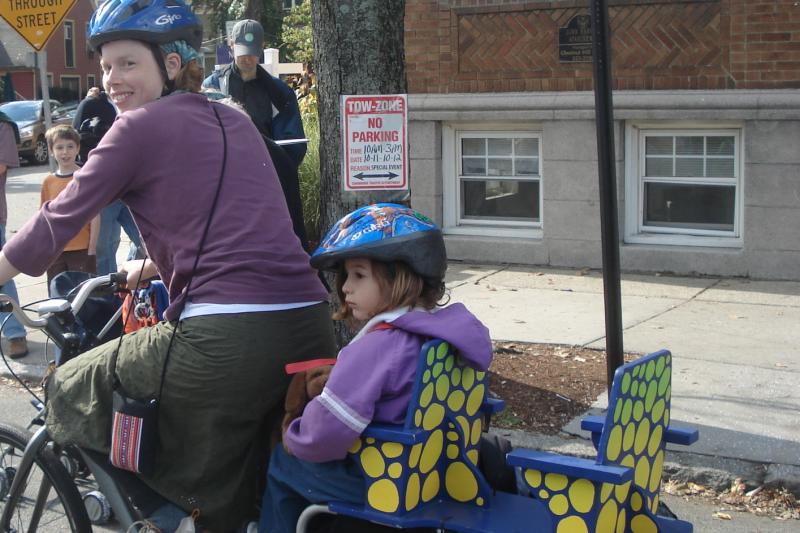
Tired of paying car insurance, sitting in traffic jams, and guzzling too much gas? Do you never want to dig your car out of another snowstorm?
Perhaps your family already cut down from two cars to one, but taking the carfree step seems impossible. Maybe you loved your carfree life back before you had kids, and every time you wrestle the kids into their car seats or take the car to the shop you pine for the old days.
You can do it — you can completely get rid of your car, even if you have a family. Yes, it can be daunting, and you will certainly have to figure out new ways to do some things, but you’ll feel a payoff quickly in your health, your place in your community, and your pocketbook. There’s nothing better than the feeling of freedom that comes from knowing you’ll never pay a parking ticket again.
This year, we’ve seen Mutual Aid in Motion.
From scaling sharing hubs to Mutual Aid 101 trainings, we’re helping communities build the tools they need.
Every dollar fuels lasting resilience – proving that when we move together, we all move forward.

Biking and Gear
The ability to ride a bike makes being carfree much easier for anyone, especially those of us who have kids.
You may already have bikes in the garage that will work just fine if you pump up the tires and get a tune-up at your local bike shop. If you have kids, you may well have picked up a child trailer, trailer bike, or child seat along the way (or maybe your neighbor has one sitting unused in the basement). Spend some time looking at the bike gear you already have, and think about how you can transport cargo and children.
Families often already have gear for carrying children for recreational riding, but don’t have a good cargo set-up since errands like grocery shopping have been done by car. If you already have a child trailer, that can easily be used for moderate cargo, though it can be difficult to carry both cargo and children at the same time with this setup.

If you have a child bike seat, consider adding either front or rear panniers (large removable bags that attach to your bike rack) to hold gear or some groceries. Note that compatibility between panniers and seats can be a problem. Consider a rear seat with front panniers (or vice versa with a seat on front and panniers on the back, though rear seats generally have higher weight limits).
If you are trying to solve compatibility issues between racks, seats, and trailers, all competing for precious space on your rig, note that many European child seats attach directly to the seat stem, in contrast to American seats that occupy your back rack. This can leave you more room for a trailer hitch or panniers. If you’ll be using a trailer or a trailer bike, consider attaching hitches to all adult bikes.
You also might consider adding some rain gear to your setup (like a rain cover for the trailer, and rain pants and jackets for adults). The number of days that you can ride comfortably, at least where we live in the New England, goes up dramatically once you are moderately protected from water.
However, that said, in our family, we still only have one set of adult rain gear, and we’re fine. Eventually, we’ll get around to investing in another set.
Keep in mind that as your family grows, your biking needs will change. Kids will outgrow standard bike seats during the pre-school years (most American seats have a 40-pound limit). Trailers will work for a while after that, but soon that won’t work either.
The most common next step from the trailer is a trailer bike (a one-wheel bike extension that allows your child to ride behind you), but like the trailer, that has an extremely limited lifespan and even worse, provides no cargo capacity.
One of the best options if you can afford it is to get a bike which is designed for carrying cargo and children. We love our Xtracycle for its ability to carry both kid and stuff in a relatively compact and maneuverable package. There are other great cargo options out there, including the Ute, a Bakfiet (Dutch “box bike”), and the Madsen (a great option for more than two kids). Prices on these options vary quite widely, ranging from about $500 to extend an existing bike into an Xtracycle, to over $3000 for a Dutch Bakfiet.
But if you have some gear, you don’t have to worry about this now. You can wait, see how your car-free lives unfold, and assess what purchase will give your family the most use when your kids are outgrowing your current set up.
What about those of you that don’t bike? If you live in an urban area, you can absolutely live well without a car and without biking by using public transit (see Bus Chick for an inspirational example). But if you are physically able, consider getting a bike and learning to ride well in traffic. There are bike instructors and schools that train adults in both basic riding and riding in traffic. You can also find additional resources online.
Backup Carfree Options & Public Transportation
In general, it is best to have at least two possible ways to get anywhere you need to go on a regular basis.
If you’ve had a car, even if it’s just one car that you rarely use, you’ve always had a fail-safe backup plan for any required trip. Even if you took almost every trip by bike, foot, or public transit, if the weather turned sour or you felt kind of sick that day, you had another option.

Biking is a fabulous primary method of transport for the carfree who are physically able, but most parents, at least those who live in northern climates, find that it’s not possible to bike every day. For those of you that live in urban areas, you will likely find a wealth of backup plans, mostly based on public transit. Taking a train or bus may take longer than biking, but is generally reliable and affordable, especially if you are able to get discounts through your employer.
Even if you live in a place with good a good train or subway network, it is also useful to get to know your local bus system. Buses generally cover far more area than subways and can provide a useful backup in case of train delays.
Before you automatically dismiss this option, thinking that maybe your area is too suburban or your town is too small for decent buses, check out what your region actually has to offer. Dorea lived for four years in Lincoln, NE, a moderately sized college town, and there were ample bus options for commuting. Suburban areas of larger cities often have buses or trains designed precisely for commuters that can provide a great backup option for a biker, even if they might take too long for comfortable use every day.
Think through all of your transportation options, including walking and “making do.” We almost always shop for groceries by bike at a store about two miles away. When the weather is prohibitive, as it sometimes is in the winter, we will sometimes borrow a car, but more often we will simply make do by shopping at a closer store with higher prices and less variety.
Carsharing
Another great backup option is a carsharing program (Zipcar in our area — you can find a list of car sharing services on Wikipedia).
This can be particularly good for someone making the transition away from car ownership. With carsharing, if you are used to driving for occasional trips, you’ll still have that option easily available. Carsharing can really help you to take the plunge; at first, you can use a car whenever you don’t see another easy way to make a trip. It won’t feel like much of a lifestyle shift, and you won’t feel deprived and resentful.
But one of the beautiful things about a carshare is that it attaches the economic cost of the car to the activity itself because you pay by the hour. So even if at first you use it a lot, you’ll soon find yourself motivated to find ways around using the car. After all, is it really worth it to spend $30 to get to Target when you could pay just a tiny bit more for a similar product from the hardware store on the corner?
When we first got rid of our car we were fairly heavy Zipcar users (2-3 times a month). But that was ages ago, and while we still maintain a membership so we can have the option, we now use it only very rarely (the last time was more than six months ago).
Borrowing a car is a great way to build community and to avoid having to have your own car. It is cheaper (and friendlier) than a formal car sharing service. If you are going to borrow your friends’ cars, it is a good idea to set some parameters ahead of time (How often can you borrow the car? For how long? How much do you contribute for gas/repairs?) and then to check in periodically to make sure your friends are still comfortable with the relationship.
Alternatively, if you know another family trying to shift away from driving, consider making your own car share, where two families share a single car and split expenses.
Finally, you can use a taxi as a fairly expensive backup option, but one that is nearly always just a phone call away.
Keep it Simple: Live Locallyto be Carfree
The real gift of being carfree is discovering that much of what you need is available within a mile or two of your home.
There are wonderful people living in your neighborhood who would love to come over for dinner. There’s a doctor and a hairdresser right around the corner and both are great with your kids. Your neighborhood park is a social hub and you’ll find you can attend a birthday party there nearly every weekend. Your children’s friends all seem to live within walking distance, so playdates are a breeze. When you take the time to look around you and stop spending so much time behind the wheel, you will find that your neighborhood is a rich area.
 When we were first carfree, we remember frequently feeling like we were backed into a corner. Suddenly there was something we couldn’t do without a car and we hadn’t planned far enough ahead to think of another way.
But now that we’ve settled into our carfree lives, we find we have ready access to two or three methods of doing our most frequent tasks, and we rarely miss having a car. Even when we do, we can get one through the car-share or borrow one from a friend, who likely barely uses her car anyway. We don’t have to spend much time or energy trying to figure out how to do things without a car. We just live our life, and enjoy the sense of local community and belonging that living without a car has brought to our family.
How are you living Carfree? Send us a message at info@shareable.net or tag us on Social to let us know.
 |
Download a free ebook: “A Year of Living Locally” (2021) |
